Computes a heteroskedasticity-consistent covariance matrix estimator for an
ordinary least squares model fitted with stats::lm(). The function returns
a rich S3 object that stores the covariance matrix, HC weights, leverage
values, method parameters, and model metadata.
Arguments
- object
An ordinary least squares model fitted by
stats::lm().- type
A character string specifying the HC estimator. The default is
"hcbeta".- ...
Method-specific constants. Unknown names are rejected. See Details for the accepted names, defaults, and parameter domains.
Value
An object of class hcinfer_vcov. The covariance matrix is stored in
object$vcov and is returned directly by vcov().
Details
For a linear model with design matrix \(X\), OLS residuals \(\hat e_t\), and HC weights \(g_t\), the estimator is
$$\widehat{\Psi}_{HC} = (X'X)^{-1} X' \widehat{\Omega} X (X'X)^{-1},$$
where \(\widehat{\Omega} = diag(\hat e_t^2 g_t)\). The supported
estimators are "hc0", "hc1", "hc2", "hc3", "hc4", "hc4m",
"hc5", "hc5m", and "hcbeta".
Additional arguments in ... are method-specific. The defaults are:
"hc0","hc1","hc2","hc3","hc4", and"hc4m": no method-specific arguments."hc5":k = 0.7."hc5m":k = 0.7,k1 = 1,k2 = 0,k3 = 1,gamma1 = 1, andgamma2 = 1.5."hcbeta":c1 = 7,c2 = 0.75,lower = 0.01,upper = 0.99,a_max = 10000, andb_max = 10000.
The HC5 adjustment factor follows the corrected expression published in the erratum to Cribari-Neto, Souza and Vasconcellos (2007), that is, \(g_t = (1 - h_t)^{-\delta_t / 2}\) with \(\delta_t = \min\{h_t / \bar h, \max\{4, k h_{\max} / \bar h\}\}\), where \(\bar h = p / n\) and \(h_{\max} = \max_t h_t\). HC5m follows Li, Zhang, Zhang and Wang (2016) and applies its own exponent \(\delta_t\) without the factor \(1/2\).
For "hc5" and "hc5m", k, k1, k2, and k3 must be nonnegative,
while gamma1 and gamma2 must be positive. For "hcbeta", c1 must be
nonnegative, c2 must be positive, and lower and upper must lie in
(0, 1) with lower < upper. The HCbeta leverage-complement truncation is
\(w_t = max(lower, min(1 - h_t, upper))\).
After shrinkage with \(\zeta = n / (n + 50)\), the Beta shape parameters
are clamped as
$$\tilde a =
\min\{\max\{(1 - \zeta) + \zeta\hat a, \epsilon\}, A_{\max}\},$$
$$\tilde b =
\min\{\max\{(1 - \zeta) + \zeta\hat b, \epsilon\}, B_{\max}\}.$$
The value \(\epsilon = 0.01\) is fixed, applied after shrinkage and before
the caps, and is not a method argument. It is distinct from lower, which
truncates \(w_t\); changing lower does not change \(\epsilon\).
Both a_max and b_max must be finite and lie in [50, 25000]; they
default to 10000 and can be set independently through ... for sensitivity
analysis. When the variance of the truncated complements is numerically
degenerate, the adjusted shapes are set directly to their respective caps.
HCbeta remains defined when \(h_t = 1\) because it truncates
\(1 - h_t\) before evaluating the Beta CDF. In contrast, HC2 through HC5m
require a strictly positive leverage complement.
References
White, H. (1980). A heteroskedasticity-consistent covariance matrix estimator and a direct test for heteroskedasticity. Econometrica, 48(4), 817-838. doi:10.2307/1912934
Hinkley, D. V. (1977). Jackknifing in unbalanced situations. Technometrics, 19(3), 285-292. doi:10.1080/00401706.1977.10489550
MacKinnon, J. G. and White, H. (1985). Some heteroskedasticity-consistent covariance matrix estimators with improved finite sample properties. Journal of Econometrics, 29(3), 305-325. doi:10.1016/0304-4076(85)90158-7
Davidson, R. and MacKinnon, J. G. (1993). Estimation and Inference in Econometrics. Oxford University Press.
Cribari-Neto, F. (2004). Asymptotic inference under heteroskedasticity of unknown form. Computational Statistics and Data Analysis, 45(2), 215-233. doi:10.1016/S0167-9473(02)00366-3
Cribari-Neto, F. and da Silva, W. B. (2011). A new heteroskedasticity consistent covariance matrix estimator for the linear regression model. AStA Advances in Statistical Analysis, 95(2), 129-146. doi:10.1007/s10182-010-0141-2
Cribari-Neto, F., Souza, T. C., and Vasconcellos, K. L. P. (2007). Inference under heteroskedasticity and leveraged data. Communications in Statistics - Theory and Methods, 36(10), 1877-1888. doi:10.1080/03610920601126589
Cribari-Neto, F., Souza, T. C., and Vasconcellos, K. L. P. (2008). Errata: Inference under heteroskedasticity and leveraged data, Communications in Statistics, Theory and Methods, 36, 1877-1888, 2007. Communications in Statistics - Theory and Methods, 37(20), 3329-3330. doi:10.1080/03610920802109210
Li, S., Zhang, N., Zhang, X., and Wang, G. (2016). A new heteroskedasticity-consistent covariance matrix estimator and inference under heteroskedasticity. Journal of Statistical Computation and Simulation, 87(1), 198-210. doi:10.1080/00949655.2016.1198906
Examples
schools <- PublicSchools |>
dplyr::mutate(
income_scaled = income / 10000,
income_scaled_sq = income_scaled^2
)
fit <- lm(expenditure ~ income_scaled + income_scaled_sq, data = schools)
cov <- vcov_hc(fit, type = "hcbeta")
cov
#>
#> ── 🥪 HCbeta robust covariance ─────────────────────────────────────────────────
#> 📐 Model: `expenditure ~ income_scaled + income_scaled_sq`
#> Dimension: 3 x 3
#> Observations: 50
#> Parameters: 3
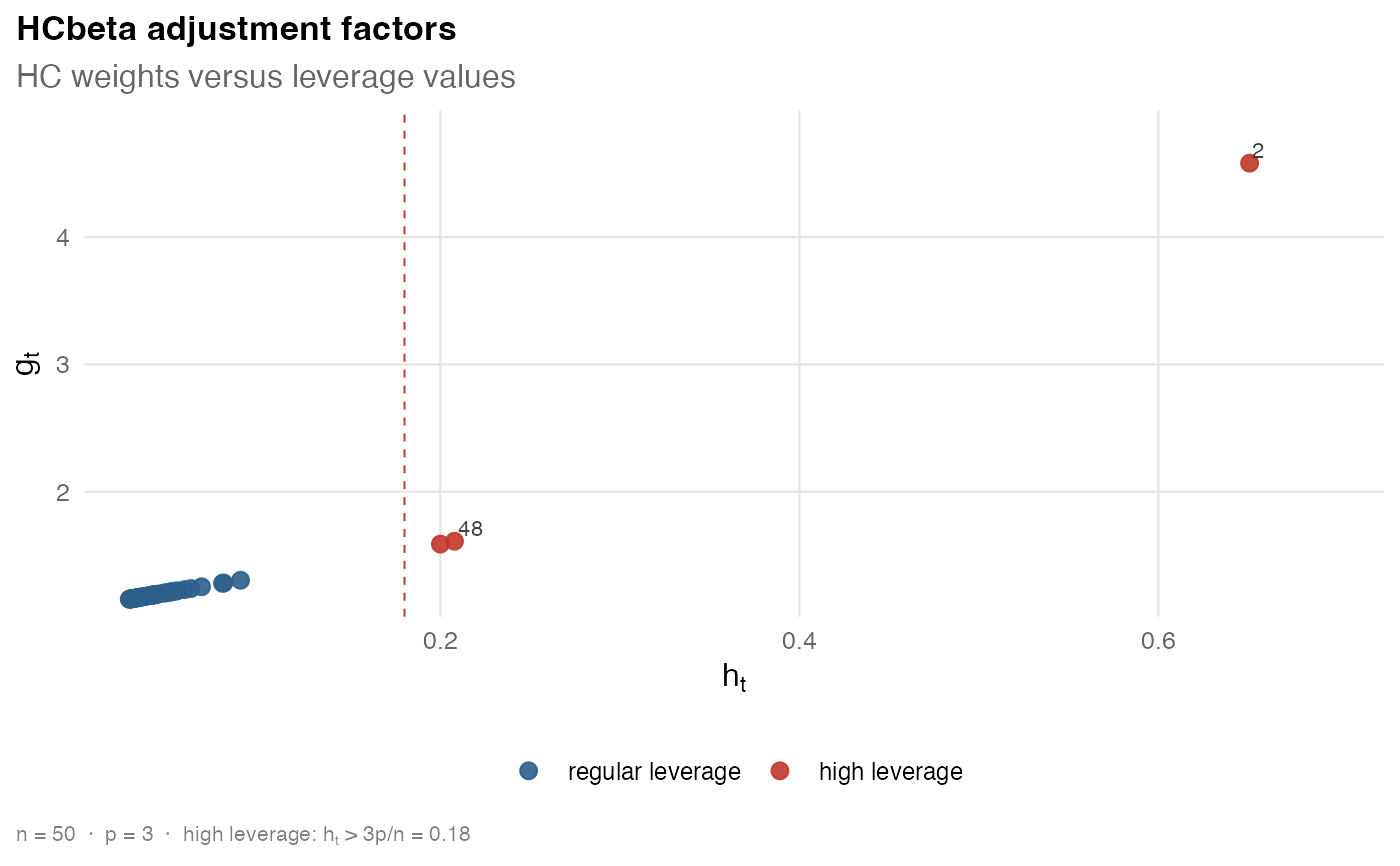
#> 🎯 Maximum leverage: 0.6508
#> ⚖️ Maximum robust weight: 4.5807
#> Use `vcov()` to extract the stored covariance matrix.
vcov(cov)
#> (Intercept) income_scaled income_scaled_sq
#> (Intercept) 723617.6 -1962262 1312195
#> income_scaled -1962262.2 5329884 -3569755
#> income_scaled_sq 1312195.3 -3569755 2394627
plot(cov)
 # Sensitivity analysis with nondefault HCbeta caps
vcov_hc(fit, type = "hcbeta", a_max = 20000, b_max = 20000)
#>
#> ── 🥪 HCbeta robust covariance ─────────────────────────────────────────────────
#> 📐 Model: `expenditure ~ income_scaled + income_scaled_sq`
#> Dimension: 3 x 3
#> Observations: 50
#> Parameters: 3
#> 🎯 Maximum leverage: 0.6508
#> ⚖️ Maximum robust weight: 4.5807
#> Use `vcov()` to extract the stored covariance matrix.
vcov_hc(fit, type = "hc5", k = 0.7)
#>
#> ── 🥪 HC5 robust covariance ────────────────────────────────────────────────────
#> 📐 Model: `expenditure ~ income_scaled + income_scaled_sq`
#> Dimension: 3 x 3
#> Observations: 50
#> Parameters: 3
#> 🎯 Maximum leverage: 0.6508
#> ⚖️ Maximum robust weight: 54.2843
#> Use `vcov()` to extract the stored covariance matrix.
vcov_hc(fit, type = "hc5m", k = 0.7, k1 = 1, k2 = 0, k3 = 1)
#>
#> ── 🥪 HC5m robust covariance ───────────────────────────────────────────────────
#> 📐 Model: `expenditure ~ income_scaled + income_scaled_sq`
#> Dimension: 3 x 3
#> Observations: 50
#> Parameters: 3
#> 🎯 Maximum leverage: 0.6508
#> ⚖️ Maximum robust weight: 8438.7828
#> Use `vcov()` to extract the stored covariance matrix.
# Sensitivity analysis with nondefault HCbeta caps
vcov_hc(fit, type = "hcbeta", a_max = 20000, b_max = 20000)
#>
#> ── 🥪 HCbeta robust covariance ─────────────────────────────────────────────────
#> 📐 Model: `expenditure ~ income_scaled + income_scaled_sq`
#> Dimension: 3 x 3
#> Observations: 50
#> Parameters: 3
#> 🎯 Maximum leverage: 0.6508
#> ⚖️ Maximum robust weight: 4.5807
#> Use `vcov()` to extract the stored covariance matrix.
vcov_hc(fit, type = "hc5", k = 0.7)
#>
#> ── 🥪 HC5 robust covariance ────────────────────────────────────────────────────
#> 📐 Model: `expenditure ~ income_scaled + income_scaled_sq`
#> Dimension: 3 x 3
#> Observations: 50
#> Parameters: 3
#> 🎯 Maximum leverage: 0.6508
#> ⚖️ Maximum robust weight: 54.2843
#> Use `vcov()` to extract the stored covariance matrix.
vcov_hc(fit, type = "hc5m", k = 0.7, k1 = 1, k2 = 0, k3 = 1)
#>
#> ── 🥪 HC5m robust covariance ───────────────────────────────────────────────────
#> 📐 Model: `expenditure ~ income_scaled + income_scaled_sq`
#> Dimension: 3 x 3
#> Observations: 50
#> Parameters: 3
#> 🎯 Maximum leverage: 0.6508
#> ⚖️ Maximum robust weight: 8438.7828
#> Use `vcov()` to extract the stored covariance matrix.