This vignette gives a compact overview of hcinfer; no
prior reading is needed.
Data and model
The examples use the PublicSchools data included with
the package. The model is the quadratic income model used in the HCbeta
application; the lm() call omits observations with missing
model variables (Wisconsin expenditure is missing, so the model fits 50
of the 51 observations).
library(hcinfer)

schools <- PublicSchools
schools$income_scaled <- schools$income / 10000
schools$income_scaled_sq <- schools$income_scaled^2

fit <- lm(expenditure ~ income_scaled + income_scaled_sq, data = schools)
fit
#>
#> Call:
#> lm(formula = expenditure ~ income_scaled + income_scaled_sq,
#>     data = schools)
#>
#> Coefficients:
#>      (Intercept)     income_scaled  income_scaled_sq
#>            832.9           -1834.2            1587.0
Available estimators
Use hc_methods() to list the estimators and their
default arguments.
hc_methods()
#> # A tibble: 9 × 4
#>   type   label  description                                    default_arguments
#>   <chr>  <chr>  <chr>                                          <chr>
#> 1 hc0    HC0    White heteroskedasticity-consistent estimator. none
#> 2 hc1    HC1    HC0 with degrees-of-freedom scaling.           none
#> 3 hc2    HC2    Leverage-adjusted estimator with exponent 1.   none
#> 4 hc3    HC3    Leverage-adjusted estimator with exponent 2.   none
#> 5 hc4    HC4    Adaptive leverage correction by Cribari-Neto.  none
#> 6 hc4m   HC4m   Modified HC4 correction by Cribari-Neto and d… none
#> 7 hc5    HC5    High-leverage correction by Cribari-Neto, Sou… k = 0.7
#> 8 hc5m   HC5m   Modified HC5 correction by Li, Zhang, Zhang, … k = 0.7, k1 = 1,…
#> 9 hcbeta HCbeta Beta-distribution leverage correction.         c1 = 7, c2 = 0.7…
Robust inference
Use hcinfer() to perform heteroskedasticity-robust
inference for an lm() object. The default estimator is
HCbeta.
result <- hcinfer(fit)
result
#>
#> ── HCbeta robust inference ─────────────────────────────────────────────────────
#> Model: `expenditure ~ income_scaled + income_scaled_sq`
#> Observations: 50 | Parameters: 3
#> Robust covariance: HCbeta
#> Confidence level: 95.0% | Normal critical value: 1.9600
#> Use `summary()` for p-values, test results, confidence intervals, and
#> diagnostics.
Use summary() for a readable report with tests on
regression coefficients, confidence intervals, leverage diagnostics, and
heteroskedasticity-robust diagnostics.
summary(result)
#>
#> ── HCbeta robust inference summary ─────────────────────────────────────────────
#>
#> ── Model ──
#>
#> Formula: `expenditure ~ income_scaled + income_scaled_sq`
#> Observations: 50 | Parameters: 3 | Residual df: 47
#>
#> ── Robust covariance ──
#>
#> Estimator: HCbeta
#> Confidence level: 95.0% | Normal critical value: 1.9600
#> Tests are two-sided normal Wald tests, one coefficient at a time.
#> Test results use alpha = 0.050.
#>
#> ── Leverage diagnostics ──
#>
#> # A tibble: 6 × 2
#>   statistic value
#>   <chr>     <chr>
#> 1 minimum   0.02669
#> 2 q1        0.03106
#> 3 median    0.03912
#> 4 mean      0.06
#> 5 q3        0.04962
#> 6 maximum   0.6508
#> Maximum leverage: observation 2 (index 2), value 0.6508
#> Average leverage: 0.0600
#> Concentration: 10.85 x average leverage
#>
#> ── Robust weights ──
#>
#> # A tibble: 6 × 2
#>   statistic value
#>   <chr>     <chr>
#> 1 minimum   1.156
#> 2 q1        1.167
#> 3 median    1.187
#> 4 mean      1.276
#> 5 q3        1.212
#> 6 maximum   4.581
#> Maximum weight: observation 2 (index 2), value 4.5807
#> Median weight: 1.1869
#> Concentration: 3.86 x median weight
#>
#> ── Method parameters ──
#>
#> # A tibble: 14 × 3
#>    parameter value    role
#>    <chr>     <chr>    <chr>
#>  1 c1        7        method constant
#>  2 c2        0.75     method constant
#>  3 lower     0.01     method constant
#>  4 upper     0.99     method constant
#>  5 a_max     1e+04    method constant
#>  6 b_max     1e+04    method constant
#>  7 mu_hat    0.94     estimated quantity
#>  8 s2_w      0.008504 estimated quantity
#>  9 phi_hat   5.632    estimated quantity
#> 10 a_hat     5.294    estimated quantity
#> 11 b_hat     0.3379   estimated quantity
#> 12 zeta      0.5      estimated quantity
#> 13 a_tilde   3.147    estimated quantity
#> 14 b_tilde   0.669    estimated quantity
#>
#> ── Coefficient tests ──
#>
#> # A tibble: 3 × 9
#>   term             estimate robust_se z       p_value alpha test_result
#>   <chr>            <chr>    <chr>     <chr>   <chr>   <chr> <chr>
#> 1 (Intercept)      832.9    850.7     0.9791  0.328   0.050 do not reject H0
#> 2 income_scaled    -1834    2309      -0.7945 0.427   0.050 do not reject H0
#> 3 income_scaled_sq 1587     1547      1.026   0.305   0.050 do not reject H0
#>   ci             ci_relation
#>   <chr>          <chr>
#> 1 [-834.3, 2500] includes null
#> 2 [-6359, 2691]  includes null
#> 3 [-1446, 4620]  includes null
#>
#> ── Confidence intervals ──
#>
#> # A tibble: 3 × 4
#>   term             null_value interval       interpretation
#>   <chr>            <chr>      <chr>          <chr>
#> 1 (Intercept)      0          [-834.3, 2500] includes null
#> 2 income_scaled    0          [-6359, 2691]  includes null
#> 3 income_scaled_sq 0          [-1446, 4620]  includes null
#> test_result is based on p_value < alpha. Do not reject H0 does not mean that H0
#> is true.
You can choose another covariance matrix estimator with
type.
result_hc3 <- hcinfer(fit, type = "hc3")
result_hc3
#>
#> ── HC3 robust inference ────────────────────────────────────────────────────────
#> Model: `expenditure ~ income_scaled + income_scaled_sq`
#> Observations: 50 | Parameters: 3
#> Robust covariance: HC3
#> Confidence level: 95.0% | Normal critical value: 1.9600
#> Use `summary()` for p-values, test results, confidence intervals, and
#> diagnostics.
Test extraction
Use tests() to extract coefficient-level Wald tests as a
tibble.
tests(result)
#> # A tibble: 3 × 8
#>   term             estimate null_value std_error z_value p_value alpha reject
#>   <chr>               <dbl>      <dbl>     <dbl>   <dbl>   <dbl> <dbl> <lgl>
#> 1 (Intercept)          833.          0      851.   0.979   0.328  0.05 FALSE
#> 2 income_scaled      -1834.          0     2309.  -0.794   0.427  0.05 FALSE
#> 3 income_scaled_sq    1587.          0     1547.   1.03    0.305  0.05 FALSE
Select a single coefficient by name or position.
tests(result, parm = "income_scaled_sq")
#> # A tibble: 1 × 8
#>   term             estimate null_value std_error z_value p_value alpha reject
#>   <chr>               <dbl>      <dbl>     <dbl>   <dbl>   <dbl> <dbl> <lgl>
#> 1 income_scaled_sq    1587.          0     1547.    1.03   0.305  0.05 FALSE
tests(result, parm = 3)
#> # A tibble: 1 × 8
#>   term             estimate null_value std_error z_value p_value alpha reject
#>   <chr>               <dbl>      <dbl>     <dbl>   <dbl>   <dbl> <dbl> <lgl>
#> 1 income_scaled_sq    1587.          0     1547.    1.03   0.305  0.05 FALSE
Change the significance level (alpha) to update the
rejection decision. The test statistic and p-value are not
recomputed.
tests(result, alpha = 0.10)
#> # A tibble: 3 × 8
#>   term             estimate null_value std_error z_value p_value alpha reject
#>   <chr>               <dbl>      <dbl>     <dbl>   <dbl>   <dbl> <dbl> <lgl>
#> 1 (Intercept)          833.          0      851.   0.979   0.328   0.1 FALSE
#> 2 income_scaled      -1834.          0     2309.  -0.794   0.427   0.1 FALSE
#> 3 income_scaled_sq    1587.          0     1547.   1.03    0.305   0.1 FALSE
Confidence interval extraction
Use confint() to extract heteroskedasticity-robust
confidence intervals.
confint(result)
#> # A tibble: 3 × 4
#>   term             conf_low conf_high level
#>   <chr>               <dbl>     <dbl> <dbl>
#> 1 (Intercept)         -834.     2500.  0.95
#> 2 income_scaled      -6359.     2691.  0.95
#> 3 income_scaled_sq   -1446.     4620.  0.95
You can select a coefficient and change the confidence level.
confint(result, parm = "income_scaled_sq")
#> # A tibble: 1 × 4
#>   term             conf_low conf_high level
#>   <chr>               <dbl>     <dbl> <dbl>
#> 1 income_scaled_sq   -1446.     4620.  0.95
confint(result, parm = "income_scaled_sq", level = 0.90)
#> # A tibble: 1 × 4
#>   term             conf_low conf_high level
#>   <chr>               <dbl>     <dbl> <dbl>
#> 1 income_scaled_sq    -958.     4132.   0.9
Coefficients and covariance matrices
The coef() method returns the OLS estimates stored in
result.
coef(result)
#>      (Intercept)    income_scaled income_scaled_sq
#>         832.9144       -1834.2029        1587.0423
The vcov() method extracts the robust covariance matrix
stored in the hcinfer object.
robust_vcov <- vcov(result)
robust_vcov
#>                  (Intercept) income_scaled income_scaled_sq
#> (Intercept)         723617.6      -1962262          1312195
#> income_scaled     -1962262.2       5329884         -3569755
#> income_scaled_sq   1312195.3      -3569755          2394627
Heteroskedasticity-robust standard errors are the square roots of the diagonal entries.
Covariance-only workflow
Use vcov_hc() when you only need the
heteroskedasticity-robust covariance matrix and diagnostics.
cov_hcbeta <- vcov_hc(fit)
cov_hcbeta
#>
#> ── HCbeta robust covariance ────────────────────────────────────────────────────
#> Model: `expenditure ~ income_scaled + income_scaled_sq`
#> Dimension: 3 x 3
#> Observations: 50
#> Parameters: 3
#> Maximum leverage: 0.6508
#> Maximum robust weight: 4.5807
#> Use `vcov()` to extract the stored covariance matrix.
The same summary() and vcov() generics work
for covariance objects.
summary(cov_hcbeta)
#>
#> ── HCbeta robust covariance summary ────────────────────────────────────────────
#>
#> ── Model ──
#>
#> Formula: `expenditure ~ income_scaled + income_scaled_sq`
#> Observations: 50 | Parameters: 3 | Residual df: 47
#>
#> ── Leverage diagnostics ──
#>
#> # A tibble: 6 × 2
#>   statistic value
#>   <chr>     <chr>
#> 1 minimum   0.02669
#> 2 q1        0.03106
#> 3 median    0.03912
#> 4 mean      0.06
#> 5 q3        0.04962
#> 6 maximum   0.6508
#> Maximum leverage: observation 2 (index 2), value 0.6508
#> Average leverage: 0.0600
#> Concentration: 10.85 x average leverage
#>
#> ── Robust weights ──
#>
#> # A tibble: 6 × 2
#>   statistic value
#>   <chr>     <chr>
#> 1 minimum   1.156
#> 2 q1        1.167
#> 3 median    1.187
#> 4 mean      1.276
#> 5 q3        1.212
#> 6 maximum   4.581
#> Maximum weight: observation 2 (index 2), value 4.5807
#> Median weight: 1.1869
#> Concentration: 3.86 x median weight
#>
#> ── Method parameters ──
#>
#> # A tibble: 14 × 3
#>    parameter value    role
#>    <chr>     <chr>    <chr>
#>  1 c1        7        method constant
#>  2 c2        0.75     method constant
#>  3 lower     0.01     method constant
#>  4 upper     0.99     method constant
#>  5 a_max     1e+04    method constant
#>  6 b_max     1e+04    method constant
#>  7 mu_hat    0.94     estimated quantity
#>  8 s2_w      0.008504 estimated quantity
#>  9 phi_hat   5.632    estimated quantity
#> 10 a_hat     5.294    estimated quantity
#> 11 b_hat     0.3379   estimated quantity
#> 12 zeta      0.5      estimated quantity
#> 13 a_tilde   3.147    estimated quantity
#> 14 b_tilde   0.669    estimated quantity
vcov(cov_hcbeta)
#>                  (Intercept) income_scaled income_scaled_sq
#> (Intercept)         723617.6      -1962262          1312195
#> income_scaled     -1962262.2       5329884         -3569755
#> income_scaled_sq   1312195.3      -3569755          2394627
You can also choose another estimator and pass its method constants.
cov_hc5 <- vcov_hc(fit, type = "hc5", k = 0.7)
cov_hc5
#>
#> ── HC5 robust covariance ───────────────────────────────────────────────────────
#> Model: `expenditure ~ income_scaled + income_scaled_sq`
#> Dimension: 3 x 3
#> Observations: 50
#> Parameters: 3
#> Maximum leverage: 0.6508
#> Maximum robust weight: 54.2843
#> Use `vcov()` to extract the stored covariance matrix.
Plots
Use plot() on an hcinfer object to display
robust confidence intervals.
plot(result)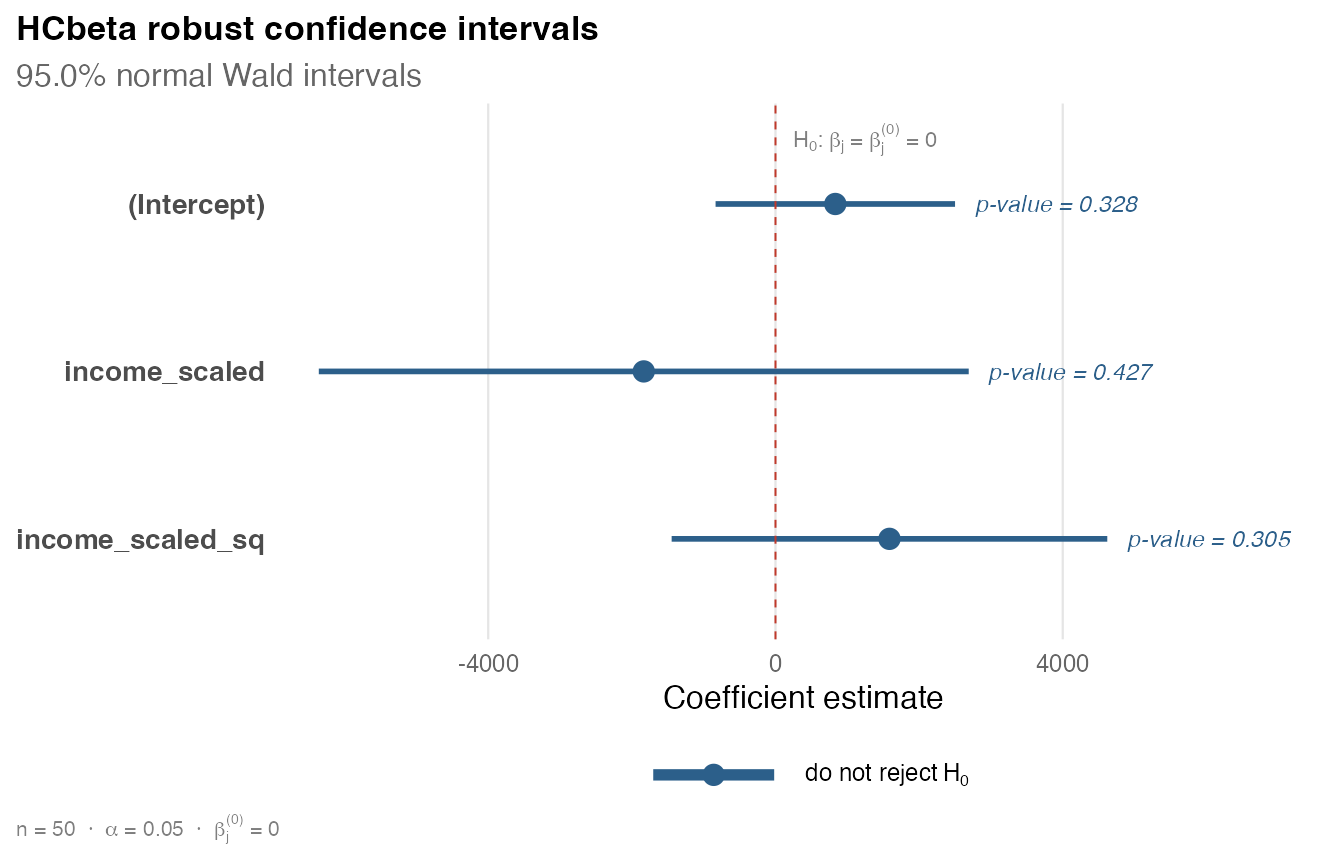
Select one coefficient with parm.
plot(result, parm = "income_scaled_sq")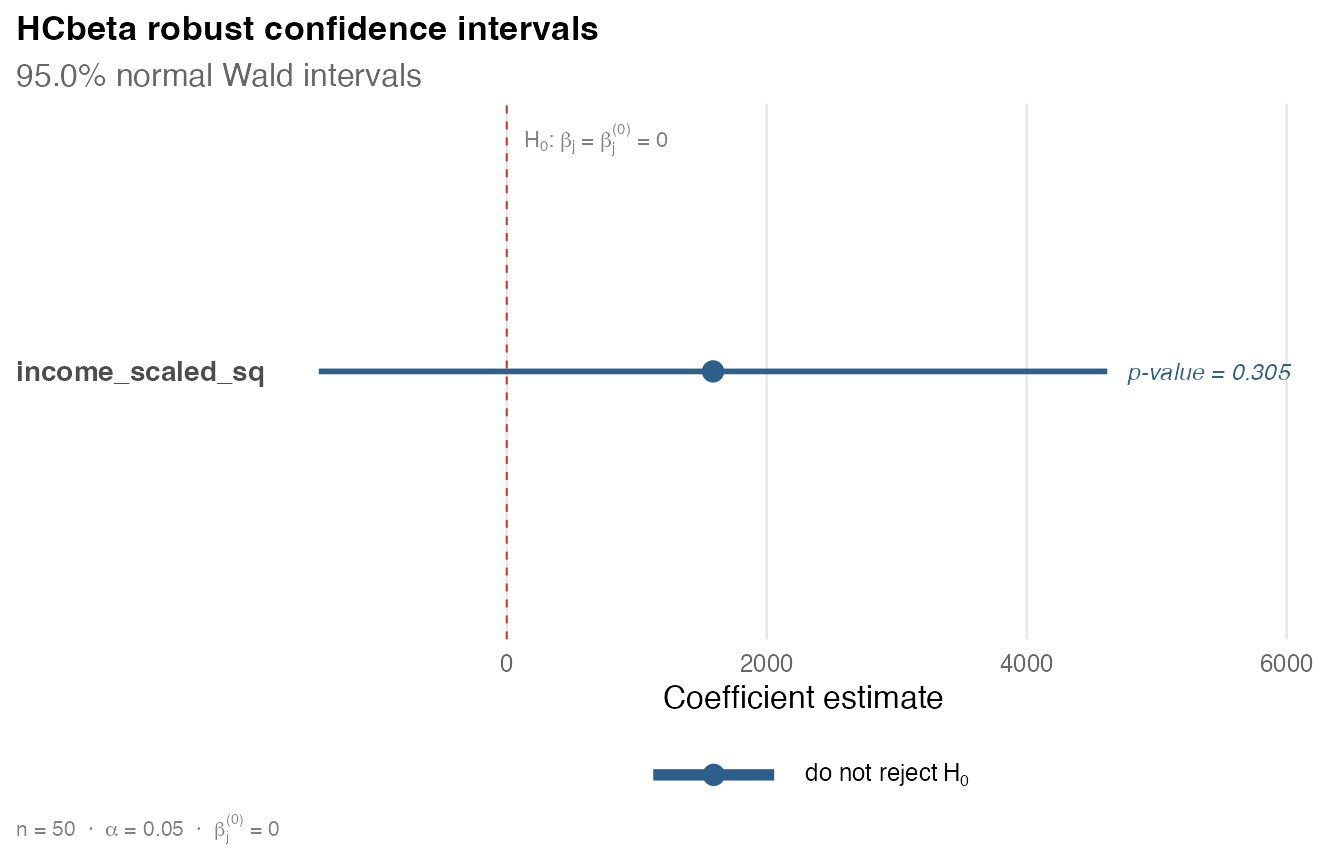
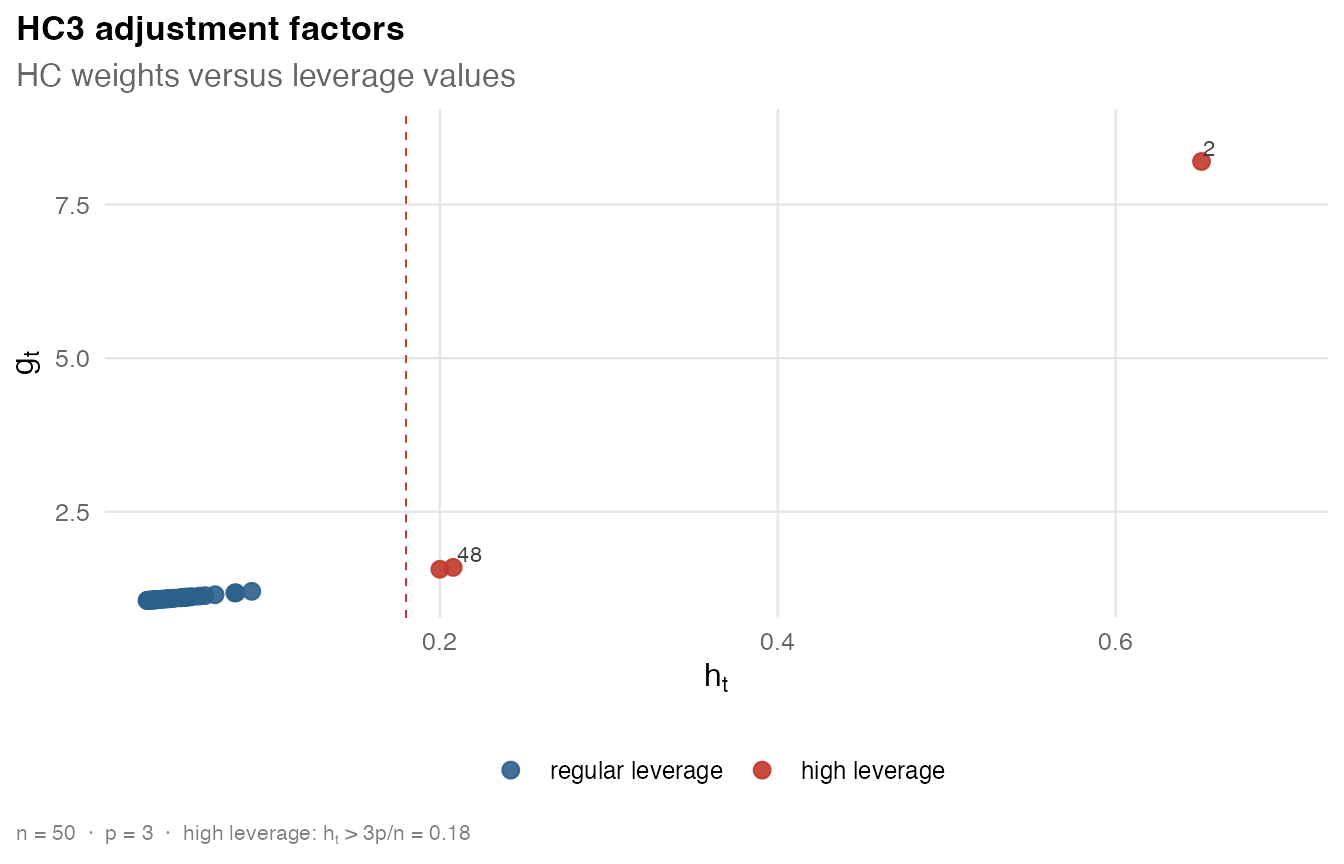
Use plot() on a vcov_hc() object to show
leverage values and HC adjustment factors.
plot(cov_hcbeta)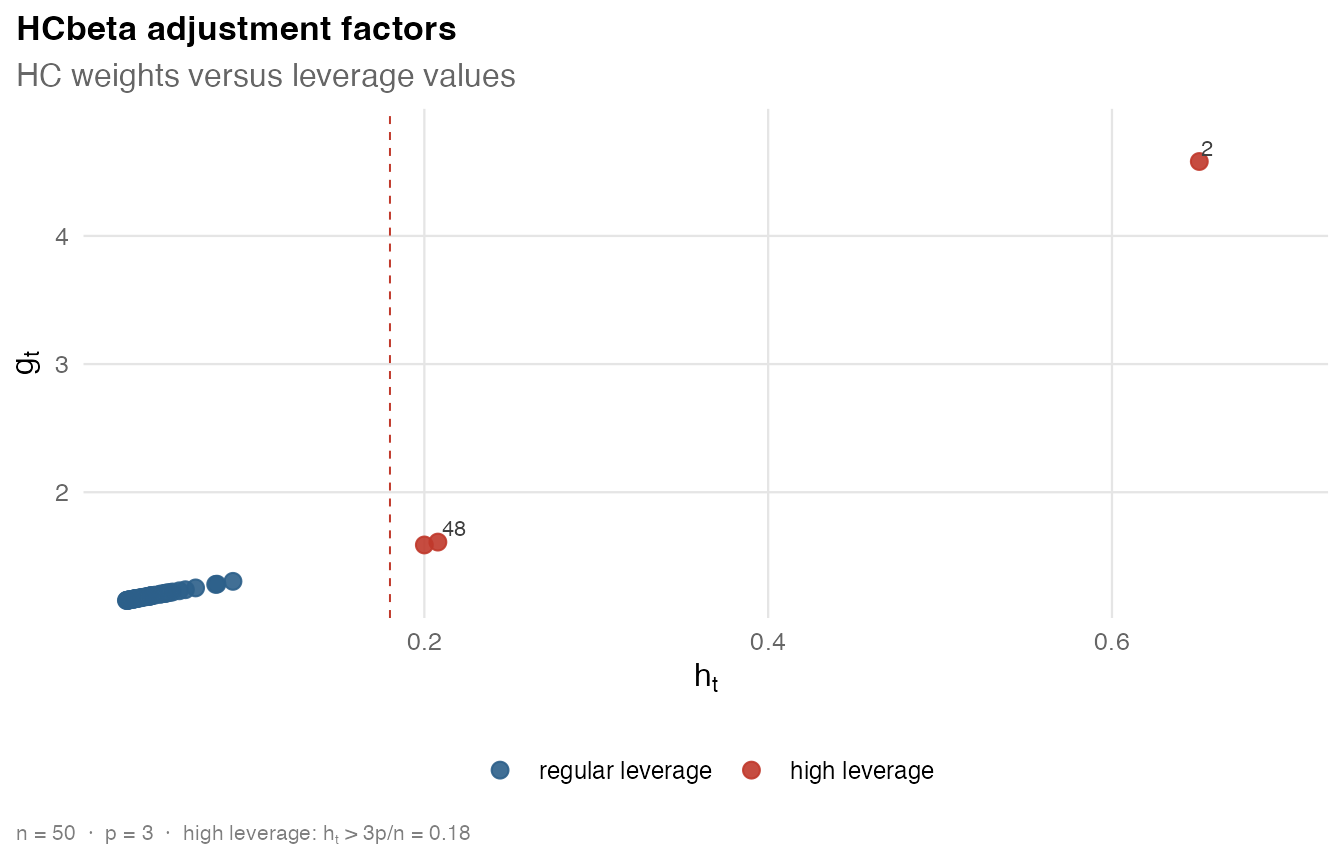
Set label_top to control how many observations with the
largest adjustment factors are labeled.