This vignette assumes the introduction
(vignette("introduction", package = "hcinfer")) and
compares several HC estimators on a single fitted model, using
coefficient tables, confidence intervals, covariance matrices, robust
weights, and leverage diagnostics.
Fit one model
Comparisons should start from one fitted model. Here we use the Boston house-price model from the HCbeta paper (price regressed on lot size, number of bedrooms, and a bedrooms-by-size interaction) and focus on the lot-size coefficient.
Run several methods
The type argument selects the HC estimator. Store each
result in a named list so that later extraction is straightforward.
Compare one coefficient
Most applied comparisons focus on one or a few coefficients. The
helper below uses tests() and confint() to
extract one coefficient and adds the method name.
extract_term <- function(result, method, term = "lotsize") {
  row <- tests(result, parm = term)
  ci <- confint(result, parm = term)

  tibble::tibble(
    method = method,
    estimate = row$estimate,
    std_error = row$std_error,
    p_value = row$p_value,
    conf_low = ci$conf_low,
    conf_high = ci$conf_high,
    reject = row$reject
  )
}

comparison <- purrr::imap(results, extract_term)
comparison <- dplyr::bind_rows(comparison)
comparison
#> # A tibble: 5 × 7
#>   method estimate std_error p_value  conf_low conf_high reject
#>   <chr>     <dbl>     <dbl>   <dbl>     <dbl>     <dbl> <lgl>
#> 1 hc0     0.00199   0.00109  0.0673 -0.000142   0.00412 FALSE
#> 2 hc3     0.00199   0.00670  0.767  -0.0111     0.0151  FALSE
#> 3 hc4     0.00199   0.0451   0.965  -0.0863     0.0903  FALSE
#> 4 hc4m    0.00199   0.0108   0.854  -0.0191     0.0231  FALSE
#> 5 hcbeta  0.00199   0.00214  0.354  -0.00222    0.00619 FALSE
Add interval widths when the goal is to compare how conservative the estimators are for this coefficient.
comparison <- comparison |>
  dplyr::mutate(interval_width = conf_high - conf_low)

comparison
#> # A tibble: 5 × 8
#>   method estimate std_error p_value  conf_low conf_high reject interval_width
#>   <chr>     <dbl>     <dbl>   <dbl>     <dbl>     <dbl> <lgl>           <dbl>
#> 1 hc0     0.00199   0.00109  0.0673 -0.000142   0.00412 FALSE         0.00426
#> 2 hc3     0.00199   0.00670  0.767  -0.0111     0.0151  FALSE         0.0263
#> 3 hc4     0.00199   0.0451   0.965  -0.0863     0.0903  FALSE         0.177
#> 4 hc4m    0.00199   0.0108   0.854  -0.0191     0.0231  FALSE         0.0423
#> 5 hcbeta  0.00199   0.00214  0.354  -0.00222    0.00619 FALSE         0.00841
Plot the robust standard errors
A simple plot can help show how the estimators differ for the selected coefficient.
ggplot2::ggplot(comparison, ggplot2::aes(x = method, y = std_error)) +
  ggplot2::geom_col(fill = "#305c8a") +
  ggplot2::labs(
    x = "Estimator",
    y = "Robust standard error for the lot-size coefficient"
  ) +
  ggplot2::theme_minimal(base_size = 12)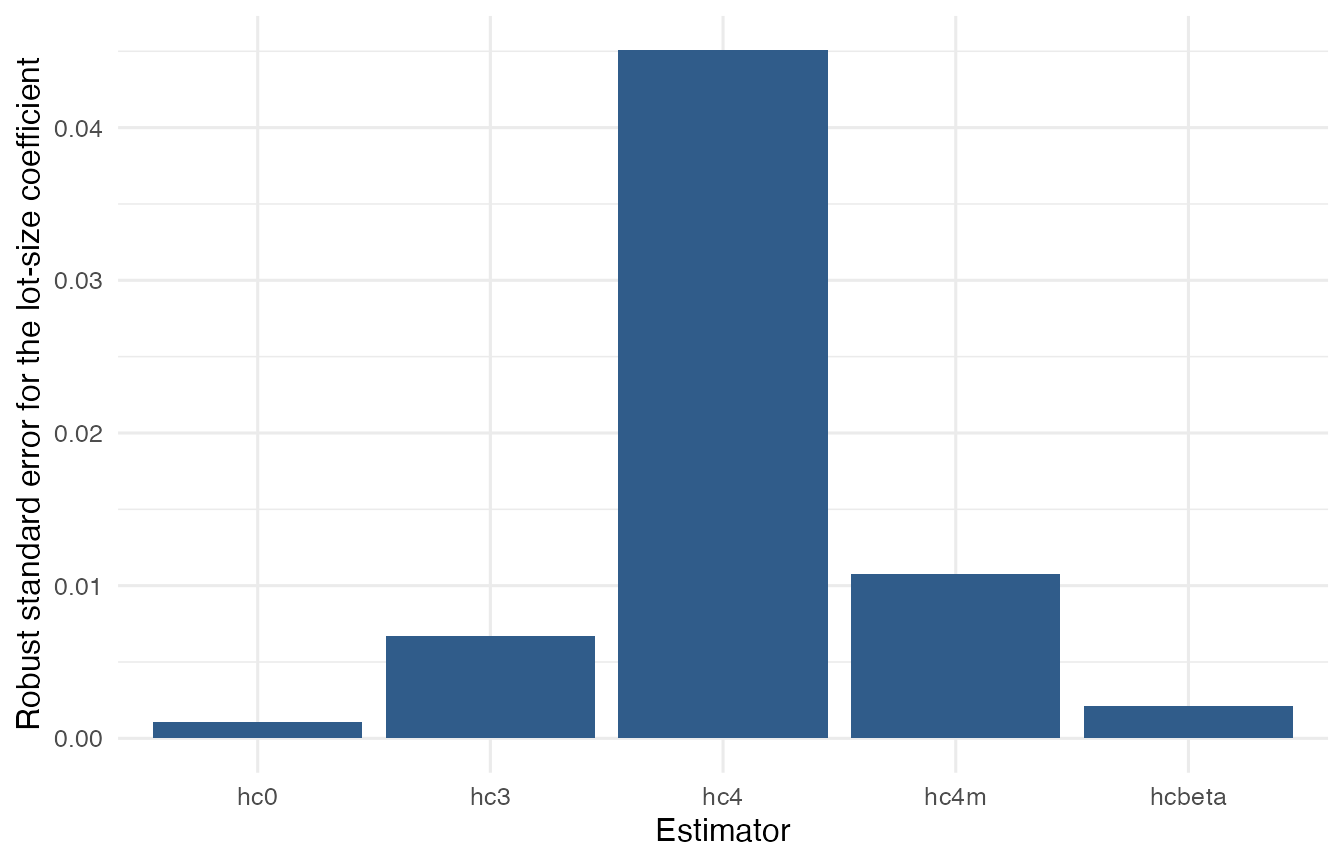
Compare confidence intervals directly
confint() returns a tibble for one result. Use the
stored comparison table when you want intervals from several methods
side by side.
comparison |>
  dplyr::select(method, conf_low, conf_high, interval_width)
#> # A tibble: 5 × 4
#>   method  conf_low conf_high interval_width
#>   <chr>      <dbl>     <dbl>          <dbl>
#> 1 hc0    -0.000142   0.00412        0.00426
#> 2 hc3    -0.0111     0.0151         0.0263
#> 3 hc4    -0.0863     0.0903         0.177
#> 4 hc4m   -0.0191     0.0231         0.0423
#> 5 hcbeta -0.00222    0.00619        0.00841
Compare covariance objects
Use vcov_hc() when you only need the covariance matrix
and diagnostics, not coefficient tests.
cov_hc3 <- vcov_hc(fit, type = "hc3")
cov_hc3
#>
#> ── HC3 robust covariance ───────────────────────────────────────────────────────
#> Model: `price ~ lotsize + bdrms + bdrms:sqrft`
#> Dimension: 4 x 4
#> Observations: 88
#> Parameters: 4
#> Maximum leverage: 0.8517
#> Maximum robust weight: 45.4824
#> Use `vcov()` to extract the stored covariance matrix.
vcov(cov_hc3)
#>               (Intercept)       lotsize         bdrms   bdrms:sqrft
#> (Intercept)  8746.3251016 -5.211208e-01 -2919.1484384  7.562435e-01
#> lotsize        -0.5211208  4.491379e-05     0.1647236 -5.637653e-05
#> bdrms       -2919.1484384  1.647236e-01  1099.5622412 -3.040083e-01
#> bdrms:sqrft     0.7562435 -5.637653e-05    -0.3040083  1.045768e-04
Plot the adjustment factors against leverage values for a covariance object.
plot(cov_hc3)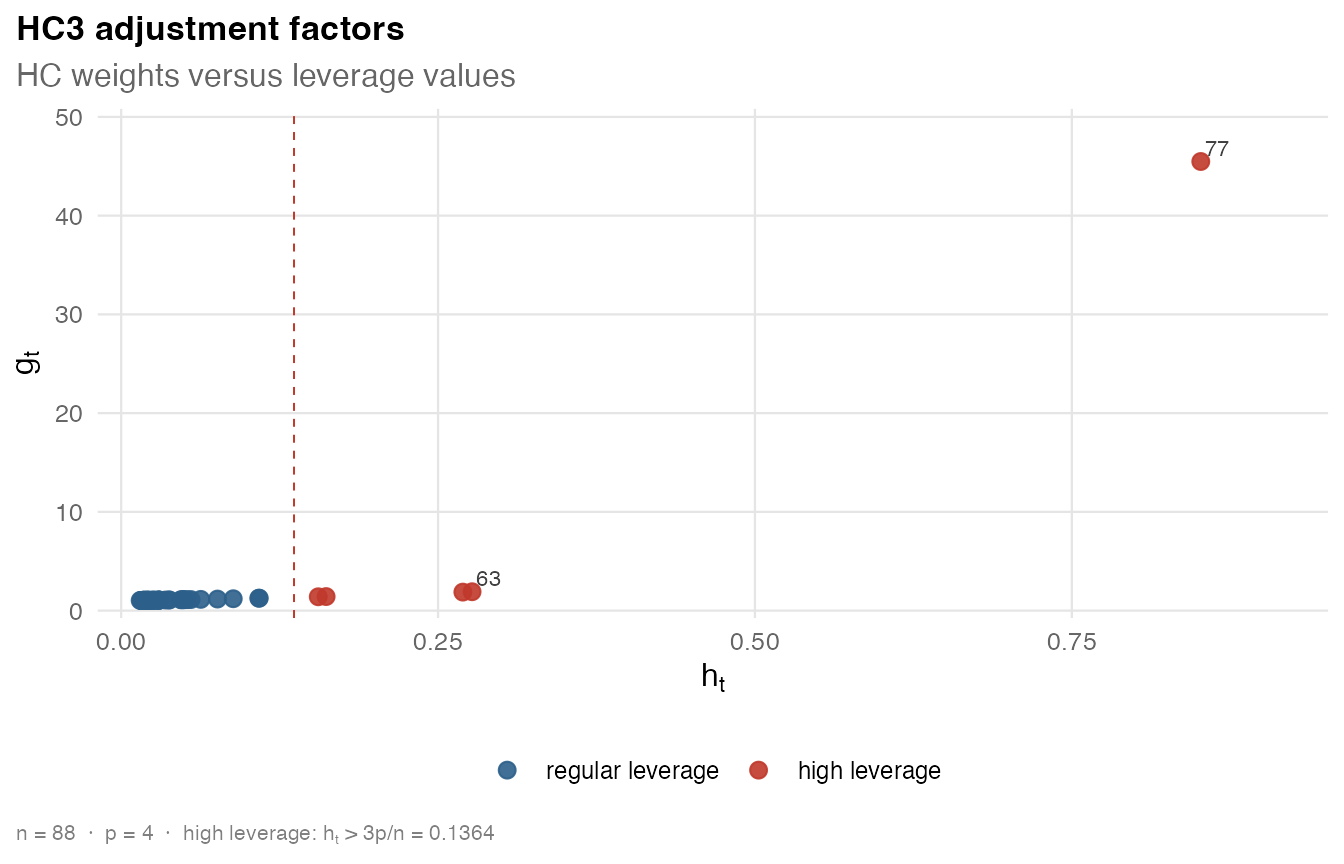
The covariance object also has a summary method.
summary(cov_hc3)
#>
#> ── HC3 robust covariance summary ───────────────────────────────────────────────
#>
#> ── Model ──
#>
#> Formula: `price ~ lotsize + bdrms + bdrms:sqrft`
#> Observations: 88 | Parameters: 4 | Residual df: 84
#>
#> ── Leverage diagnostics ──
#>
#> # A tibble: 6 × 2
#>   statistic value
#>   <chr>     <chr>
#> 1 minimum   0.01498
#> 2 q1        0.01772
#> 3 median    0.02034
#> 4 mean      0.04545
#> 5 q3        0.02978
#> 6 maximum   0.8517
#> Maximum leverage: observation 77 (index 77), value 0.8517
#> Average leverage: 0.0455
#> Concentration: 18.74 x average leverage
#>
#> ── Robust weights ──
#>
#> # A tibble: 6 × 2
#>   statistic value
#>   <chr>     <chr>
#> 1 minimum   1.031
#> 2 q1        1.036
#> 3 median    1.042
#> 4 mean      1.591
#> 5 q3        1.062
#> 6 maximum   45.48
#> Maximum weight: observation 77 (index 77), value 45.4824
#> Median weight: 1.0420
#> Concentration: 43.65 x median weight
#>
#> ── Method parameters ──
#>
#> No additional method parameters.
Compare diagnostics across methods
All covariance and inference objects store robust weights and leverage values. The leverage values depend only on the fitted model, while the weights depend on the HC estimator.
covariances <- purrr::map(methods, \(method) {
  vcov_hc(fit, type = method)
})
names(covariances) <- methods

diagnostic_comparison <- purrr::imap(covariances, \(cov, method) {
  tibble::tibble(
    method = method,
    max_leverage = max(cov$leverage),
    max_weight = max(cov$weights),
    median_weight = stats::median(cov$weights)
  )
})
diagnostic_comparison <- dplyr::bind_rows(diagnostic_comparison)
diagnostic_comparison
#> # A tibble: 5 × 4
#>   method max_leverage max_weight median_weight
#>   <chr>         <dbl>      <dbl>         <dbl>
#> 1 hc0           0.852       1             1
#> 2 hc3           0.852      45.5           1.04
#> 3 hc4           0.852    2069.            1.01
#> 4 hc4m          0.852     118.            1.02
#> 5 hcbeta        0.852       4.42          1.13
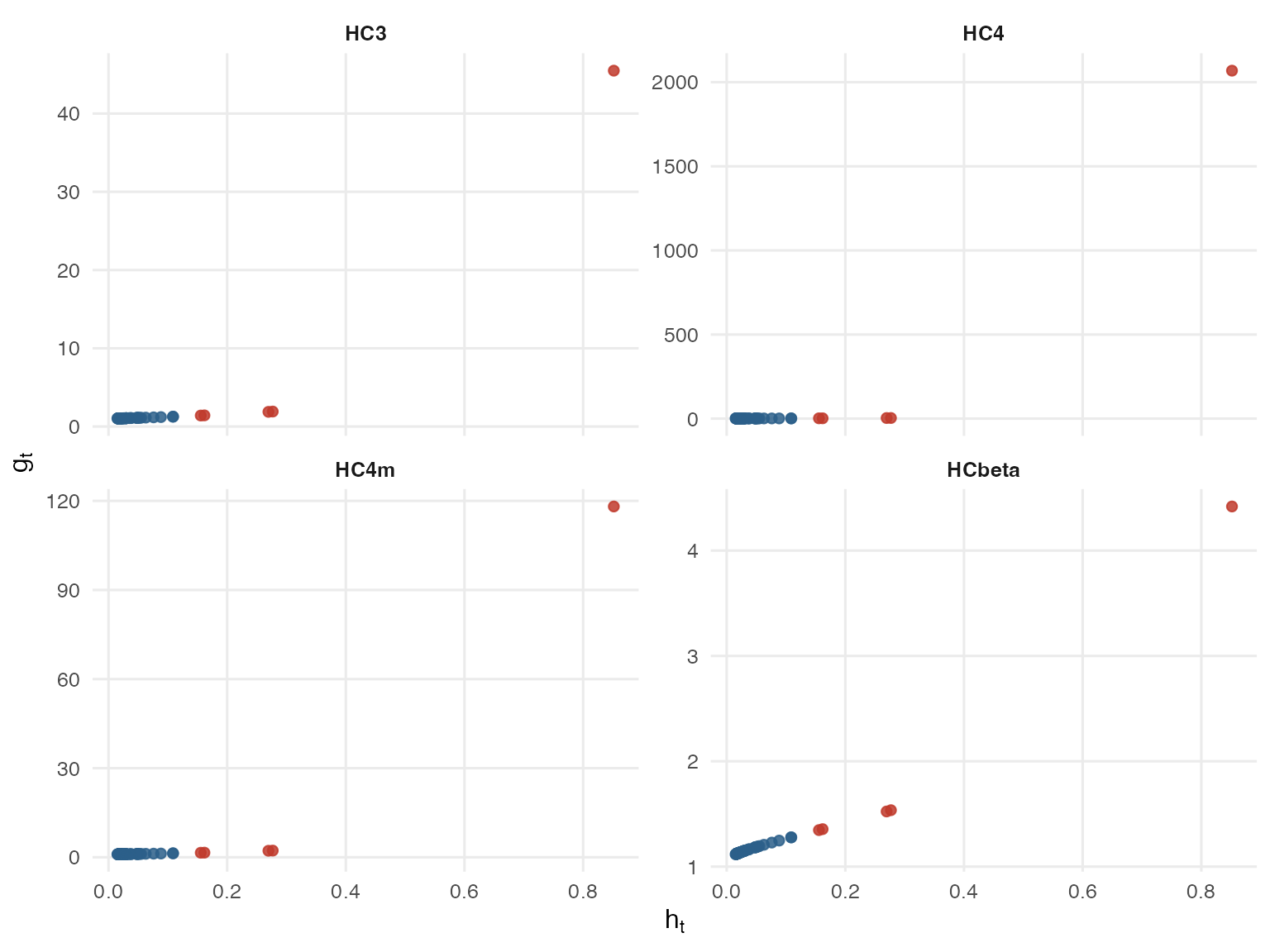
The next figure mirrors the empirical display in the HCbeta paper: adjustment factors are plotted against leverages for HC3, HC4, HC4m, and HCbeta.
figure_methods <- c("hc3", "hc4", "hc4m", "hcbeta")
figure_covariances <- purrr::map(figure_methods, \(method) {
  vcov_hc(fit, type = method)
})
names(figure_covariances) <- figure_methods

weight_comparison <- purrr::imap(figure_covariances, \(cov, method) {
  tibble::tibble(
    method = cov$label,
    leverage = cov$leverage,
    weight = cov$weights,
    high_leverage = cov$leverage > 3 * cov$p / cov$n
  )
}) |>
  dplyr::bind_rows() |>
  dplyr::mutate(
    method = factor(method, levels = c("HC3", "HC4", "HC4m", "HCbeta"))
  )

ggplot2::ggplot(weight_comparison, ggplot2::aes(x = leverage, y = weight)) +
  ggplot2::geom_point(
    ggplot2::aes(color = high_leverage),
    size = 1.8,
    alpha = 0.85
  ) +
  ggplot2::facet_wrap(~method, scales = "free_y", ncol = 2) +
  ggplot2::scale_color_manual(
    values = c(`FALSE` = "#2c5f8a", `TRUE` = "#c0392b"),
    guide = "none"
  ) +
  ggplot2::labs(
    x = expression(h[t]),
    y = expression(g[t])
  ) +
  ggplot2::theme_minimal(base_size = 12) +
  ggplot2::theme(
    strip.text = ggplot2::element_text(face = "bold"),
    panel.grid.minor = ggplot2::element_blank()
  )
What to report
A compact reporting table usually needs the estimator, estimate, robust standard error, p-value, and interval endpoints.
comparison |>
  dplyr::select(method, estimate, std_error, p_value, conf_low, conf_high)
#> # A tibble: 5 × 6
#>   method estimate std_error p_value  conf_low conf_high
#>   <chr>     <dbl>     <dbl>   <dbl>     <dbl>     <dbl>
#> 1 hc0     0.00199   0.00109  0.0673 -0.000142   0.00412
#> 2 hc3     0.00199   0.00670  0.767  -0.0111     0.0151
#> 3 hc4     0.00199   0.0451   0.965  -0.0863     0.0903
#> 4 hc4m    0.00199   0.0108   0.854  -0.0191     0.0231
#> 5 hcbeta  0.00199   0.00214  0.354  -0.00222    0.00619
Use this comparison to document how sensitive your conclusion is to
the choice of HC estimator. Use vignette("hcinfer-hcbeta")
for a closer look at the default HCbeta estimator.